Kevlar
Why Kevlar® Webbing Is the Preferred Wick Material for Fire Performance Equipment
Jul
Why Kevlar® Webbing Is the Preferred Wick Material for Fire Performance Equipment
Understanding the Material, Weaving Technology and Applications

When manufacturing fire performance equipment, selecting the right wick material is one of the most important decisions. The wick directly affects flame stability, fuel absorption, burn duration and the overall safety of the equipment.
Among all high-temperature fibers available today, Kevlar® aramid fiber webbing has become the preferred material for professional fire props worldwide.
What Is Kevlar®?
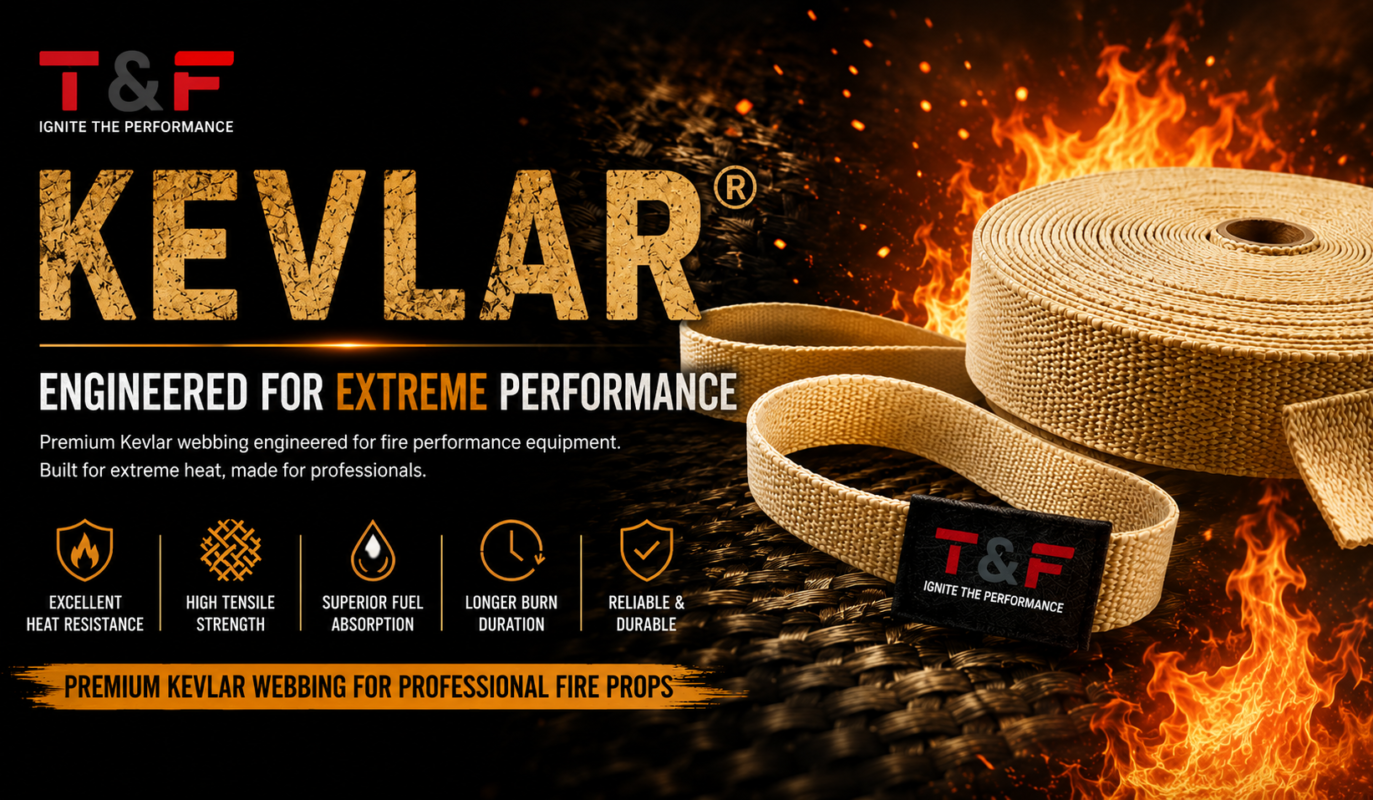
Kevlar® is a para-aramid synthetic fiber originally developed by DuPont. It is widely recognized for its exceptional strength, heat resistance and durability.

Unlike ordinary cotton or polyester fibers, Kevlar is engineered to withstand extreme working environments while maintaining structural integrity.
Its unique molecular structure provides:
- Excellent thermal stability
- High tensile strength
- Outstanding abrasion resistance
- Low elongation under load
- Long service life
These properties make Kevlar suitable for aerospace, military, industrial protection—and professional fire performance equipment.
Why Kevlar Is Ideal for Fire Wicks

Professional fire props require a wick that can repeatedly absorb fuel, sustain combustion and resist degradation.
Kevlar webbing offers several advantages:
Excellent Heat Resistance
Kevlar does not melt like synthetic fibers.
Instead, it maintains its structural strength even under prolonged exposure to high temperatures, making it suitable for repeated fire performances.
High Fuel Absorption
The woven structure allows the webbing to retain liquid fuel efficiently.
Proper fuel retention results in:
- Longer burn time
- More stable flames
- Improved performance consistency
Outstanding Mechanical Strength
Fire props experience continuous impact, twisting and tension.
Kevlar’s high tensile strength helps prevent premature failure during use.
Longer Service Life
Compared with conventional wick materials, high-quality Kevlar webbing typically provides significantly longer service life under proper operating conditions.
This reduces replacement frequency and lowers operating costs.
Professional Weaving Technology
The performance of Kevlar webbing depends not only on the fiber itself but also on the weaving process.
Professional manufacturing focuses on several critical parameters.
Fiber Composition
Available options include:
- 100% Para-Aramid Kevlar
- Kevlar blended with fiberglass
- Customized fiber combinations for specific applications
Different compositions provide different balances between flexibility, rigidity and cost.
Weaving Structure

Common weave types include:
- Plain Weave
- Twill Weave
- Tubular Weave
- Reinforced Multi-layer Weave
Each structure influences:
- Fuel absorption
- Flame distribution
- Flexibility
- Wear resistance
Thickness
Typical thickness:
1.5 mm – 6 mm
Thicker webbing generally stores more fuel and provides longer burn duration, while thinner webbing offers greater flexibility.
Width Options
Common widths include:
- 25 mm (1″)
- 38 mm (1.5″)
- 50 mm (2″)
- 75 mm (3″)
- 100 mm (4″)
Custom widths are available for OEM projects.
Density
Weaving density directly affects:
- Fuel capacity
- Burning efficiency
- Mechanical strength
- Overall durability
Professional manufacturers maintain consistent density through precision weaving equipment.
Common Applications

Kevlar webbing is widely used in professional fire performance equipment, including:
Fire Fans
One of the most popular applications.
Kevlar strips are securely fastened to the fan frame, providing large, stable flames.
Fire Poi
Kevlar is wrapped around poi heads to create long-lasting burning surfaces.
Fire Staff
Used on both ends of the staff to produce symmetrical flames.
Fire Hoops
Kevlar sections are installed around the hoop to create multiple ignition points.
Fire Swords
High-density Kevlar webbing is fixed to the blade to generate controlled flame effects.
Custom Fire Props
Many manufacturers also use Kevlar in:
- Dragon Staff
- Fire Rope Dart
- Palm Torches
- Contact Props
- Stage Performance Equipment
Key Factors When Choosing Kevlar Webbing

When sourcing Kevlar webbing, buyers should evaluate more than price.
Important considerations include:
✔ Genuine para-aramid fiber
✔ Consistent weaving quality
✔ Stable thickness
✔ Accurate width tolerance
✔ Heat-resistant stitching
✔ Reliable production consistency
✔ OEM customization capability
A professional supplier should also provide technical support and recommend suitable specifications for different fire props.
OEM Manufacturing Services

For brands and fire equipment manufacturers, OEM capabilities are equally important.
Typical customization includes:
- Custom widths
- Custom thickness
- Roll length
- Cutting service
- Pre-sewn wicks
- Reinforced stitching
- Custom packaging
- Private Label
Conclusion
Kevlar webbing has become the industry standard for professional fire performance equipment because it combines heat resistance, mechanical strength and long-term durability.
However, the quality of the finished product depends not only on the Kevlar fiber itself, but also on precise weaving technology, consistent manufacturing and proper quality control.
Choosing an experienced manufacturer ensures reliable performance, consistent production and long-lasting fire equipment.
About T&F

At T&F, we specialize in manufacturing high-quality Kevlar webbing and fire performance equipment components for brands, distributors and OEM customers worldwide.
Our capabilities include:
- 100% Kevlar Webbing
- Kevlar/Fiberglass Webbing
- Custom Width & Thickness
- Fire Fan Wick
- Fire Poi Wick
- Fire Staff Wick
- OEM & Private Label
- Fast Sampling
- Worldwide Shipping
Looking for a reliable Kevlar webbing manufacturer? Contact T&F to discuss your next project.
Email: [email protected]
WhatsApp: 008618033458032
Website: www.buyfirefans.com
