Kevlar
100% Pure Kevlar vs. Kevlar & Fiberglass Blend: Which Wick Material Should You Choose?
Aug
When choosing wick or webbing materials for fire performance props, one of the most common questions we receive is:
Should I choose 100% pure Kevlar, or a Kevlar & fiberglass blended material?

There is no single answer that works for every application.
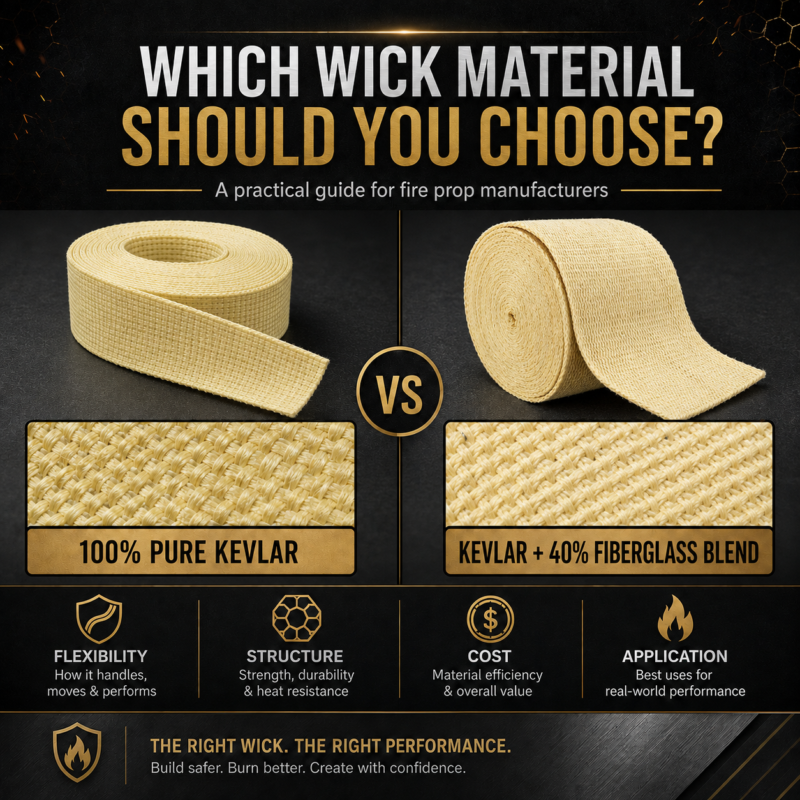
Both materials can be suitable for fire prop manufacturing, but they have different characteristics in terms of flexibility, structure, durability, cost, and handling.
Understanding these differences can help you select the right material for your product.
1. What Is 100% Pure Kevlar Webbing?

100% pure Kevlar webbing is made from aramid fiber yarn without fiberglass being added to the main woven structure.
One of its most noticeable characteristics is its relatively soft and flexible feel.
Main Characteristics
- Soft and flexible structure
- Easy to wrap around different prop shapes
- Good toughness
- Suitable for applications requiring repeated bending or wrapping
- Premium material option
- Available in different widths, thicknesses, and weaving structures
Because of its flexibility, pure Kevlar webbing is often selected by manufacturers producing products such as:
Fire fans, fire poi, fire staffs, fire swords, torches and other customized fire props.
For designs where the wick needs to bend, fold or wrap tightly around the metal structure, pure Kevlar is often a convenient choice.
2. What Is Kevlar & Fiberglass Blended Webbing?

Kevlar & fiberglass blended webbing combines aramid fibers with fiberglass fibers in the woven construction.
Adding fiberglass changes the physical feel and structure of the material.
Compared with pure Kevlar, blended webbing is normally more structured and less flexible.
Main Characteristics
- Firmer structure
- Good dimensional stability
- Less deformation during handling
- Suitable for applications where a more rigid wick structure is preferred
- Cost-effective option for larger production quantities
- Available in multiple widths and thicknesses
For customers producing fire props in larger volumes, blended material can provide a practical balance between performance, structure and production cost.
3. Pure Kevlar vs. Kevlar/Fiberglass Blend
Feature100% Pure KevlarKevlar + Fiberglass BlendMaterialAramid fiberAramid + fiberglassFlexibilityHigherLowerFeelSofterFirmerWrapping & shapingEasierMore structuredDimensional stabilityGoodVery goodCostHigherMore economicalBest suited forFlexible and premium designsStructured and cost-conscious production
The important point is that one material is not automatically better than the other.
The correct choice depends on the final product.
4. Which One Should You Choose?

Choose 100% Pure Kevlar When:
Your design requires the wick to wrap tightly around a frame.
You prefer a softer and more flexible material.
Your product is positioned as a premium fire prop.
The wick needs to tolerate frequent bending or shaping during assembly.
You want maximum flexibility when developing customized designs.
Choose Kevlar & Fiberglass Blend When:
You prefer a firmer and more structured webbing.
The product design does not require extensive bending.
You are producing larger quantities and need better cost control.
You want the wick to maintain its shape during manufacturing.
Your application requires a balance between material performance and price.
5. Material Is Only Part of the Wick Performance
When evaluating fire wick materials, the fiber composition is important—but it is not the only factor.
Actual performance can also be affected by:
- Webbing thickness
- Width
- Weaving density
- Weaving structure
- Number of layers
- Fuel type
- Fuel absorption
- Prop construction
- Exposure time
- Operating environment
For this reason, we always recommend testing the selected material with the actual prop design and intended operating conditions before mass production.
A thicker wick is not automatically better, and pure Kevlar is not automatically the best choice for every product.
The right combination of material + weave + dimensions + prop design is what matters.
6. How We Help Fire Prop Manufacturers Choose

For customers who are unsure which material works best for their products, sampling is often the easiest solution.
We can provide different options of:
100% Pure Kevlar Webbing
and
Kevlar & Fiberglass Blended Webbing
with different:
- Widths
- Thicknesses
- Weaving patterns
- Roll lengths
- Customized specifications
You can compare the materials directly and test them on your own fire fan, poi, staff, sword or other prop designs before confirming a larger order.
Which Material Is Right for Your Fire Props?

If your priority is flexibility and a premium material structure, 100% pure Kevlar may be the better choice.
If your priority is structure, dimensional stability and cost efficiency, Kevlar & fiberglass blended webbing may be worth considering.
There is no universal “best wick.”
There is only the material that best matches your design, your manufacturing process and your target market.
If you are developing a new fire prop or looking for a different wick specification, feel free to contact us with your required width, thickness, material and application.
We can help you compare suitable options before production.
#Kevlar #KevlarWebbing #FireWick #FireProps #FirePerformance #FirePoi #FireFans #FireStaff #FireSword #FlowArts #FlowProps #FireDancing #FirePropSupplier #OEM #CustomManufacturing #AramidFiber #Fiberglass #FirePerformanceEquipment
Contact our fire Specilist:
WhatsaApp: 008618033458032
Email: [email protected]
www.buyfirefans.com
